| XGtd Overview |
The
latest release of XGtd® includes significant improvements and added
functionality to both the user interface and propagation modeling. New
features now available in Release 2.4 include 3D antenna radiation
patterns, the ability to run calculations on multiple processors,
improved error checking on imported CAD data, and much more. For
detailed descriptions of all the new features in Release 2.4, please
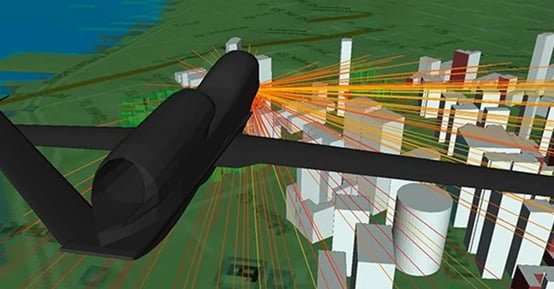
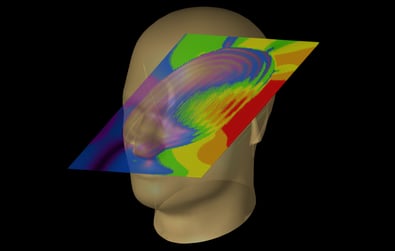
refer to the OverviewXGtd is a general purpose ray-based electromagnetic analysis tool for analyzing propagation in the vicinity of complex objects, such as aircraft and vehicles. XGtd utilizes the Uniform Theory of Diffraction (UTD) to model all important mechanisms that contribute to electromagnetic wave propagation around complex objects at high frequencies. The software can be applied to a broad range of electrically large radiation, scattering, and EMC/EMI problems. Specific applications include antenna placement analysis, which can involve both the effects of the structure on an antenna’s far zone radiation pattern as well as interference with other antennas mounted on the same structure. The co- and cross-polarized components of the far zone radar cross section (RCS) can be computed as a function of frequency, incident angle or bistatic scattering angle. XGtd can also be used to analyze propagation inside an anechoic chamber and includes several special features aimed at this application. The powerful, user-friendly GUI is an efficient tool for importing CAD files of complex objects, specifying transmitter and receiver locations, setting calculation parameters, running calculations, and viewing the output. Output includes near zone fields, far zone antenna patterns and antenna coupling and interference measures. Display of the ray paths, color-coded to indicate signal strength, is possible in addition to planar field displays of field strength. The user interface module runs on the Windows XP and Vista operating systems. The propagation analysis modules run on both Windows and Linux operating systems and can take advantage of multiple processors to reduce the computation time. |
||||||||||