As telecommunications standards have shifted toward higher frequencies such as millimeter waves, it has become necessary to incorporate arrays of antennas into communication systems. These more sophisticated arrays enable higher gain, smaller beam width patterns that can overcome the high path losses inherent to these frequencies and help deliver the higher throughput promised by these new standards. Even for small arrays with just a few elements,it can be difficult to fully understand the coverage possible with different power and phasing combinations. When arrays grow larger and contain tens or even hundreds of elements, advanced tools are required to fully describe the operation and effectiveness of the design. XFdtd® Electromagnetic Simulation Software contains analysis tools for rapidly characterizing the performance of arrays of antennas for beamforming and beam steering applications. Superposition allows for rapid synthesis of complex problems from basic data obtained from an electromagnetic simulation by quickly overlaying data in a linear space.
For example, consider multiple antennas in a problem space. Requisite data, such as S-Parameters, efficiency, and far-zone are computed once in the EM simulation for each antenna of interest. These may be quickly combined with complex scaling to yield the radiation pattern and associated active S-Parameters and efficiency for any desired antenna power and phasing combination. For situations where specific port power and phasing options are known ahead of time, the resulting far-zone pattern is computed immediately in post-processing.
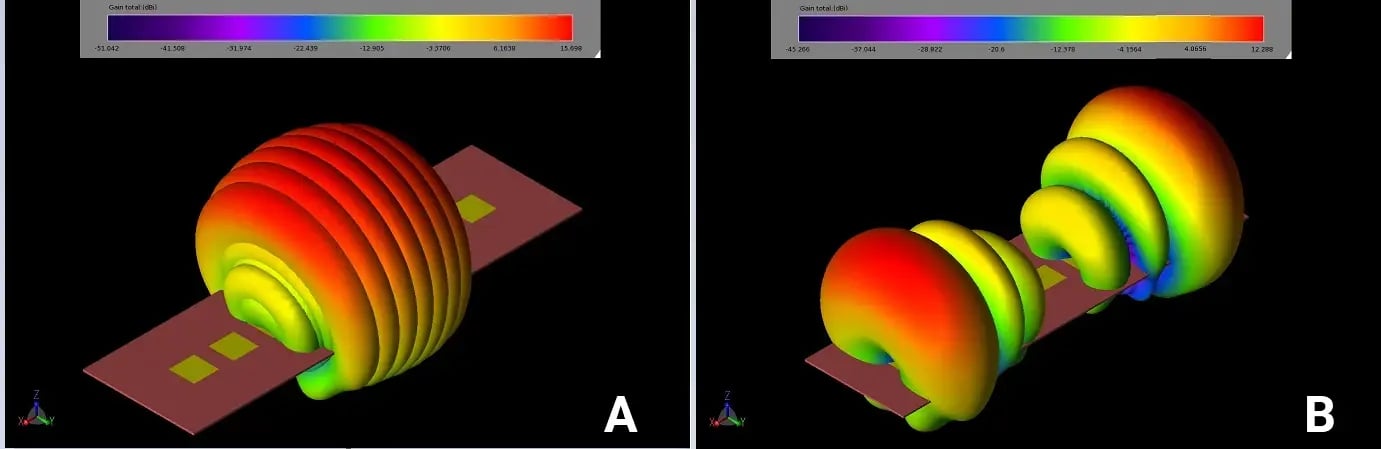 Fig. 1 Patterns of a 1x8 linear array (a) and two 1x4 linear arrays (b) of patch elements, simulated using the superposition feature in XFdtd.
A second situation is where the specific beam directions are known in advance and the power and phasing of the ports is desired to maximize the Effective Isotropic Radiated Power (EIRP) in those directions. Using statistical analysis, the coverage provided by the array for all possible directions may be determined by the calculation of the cumulative distribution function of the EIRP which shows the percent of the spherical far-zone volume with positive gain for a given input power.
We can also examine a 1x8 array of 28 GHz patch antenna elements where the phasing between elements is swept using the superposition feature from -90 to 90 degrees in 30-degree steps. Seven unique beams will be created which focus a fan beam between -30 and 30 degrees, as shown in Figure 1a. If the array is used in a configuration with two adjacent 1x4 subarrays, the superposition feature can be used to generate separate patterns for each subarray as well, such as shown in Figure 1b.
Alternatively, for situations where the desired beam directions are known and the port settings are desired, the array optimization feature is available. A large, two-dimensional array, such as an 8x8 patch array at 28 GHz, will create narrow beams which can be swept over a broad range of directions above the array. Figure 2 shows the Max Hold pattern created with the array optimization tool for a case where the beams are desired at every 15 degrees in the azimuthal direction and an elevation angle down 30 degrees from normal. Following the calculation, the necessary port power and phasing requirements of the elements to form each beam are available.
A large array may also be operated as a set of smaller sub-arrays which function independently. In Figure 3 the same 8x8 array is shown functioning as a set of four 4x4 arrays which each have their own unique power and phasing arrangements to communicate with unique receivers. Using the array analysis tools, the sub-arrays may be defined and the operating characteristics explored.
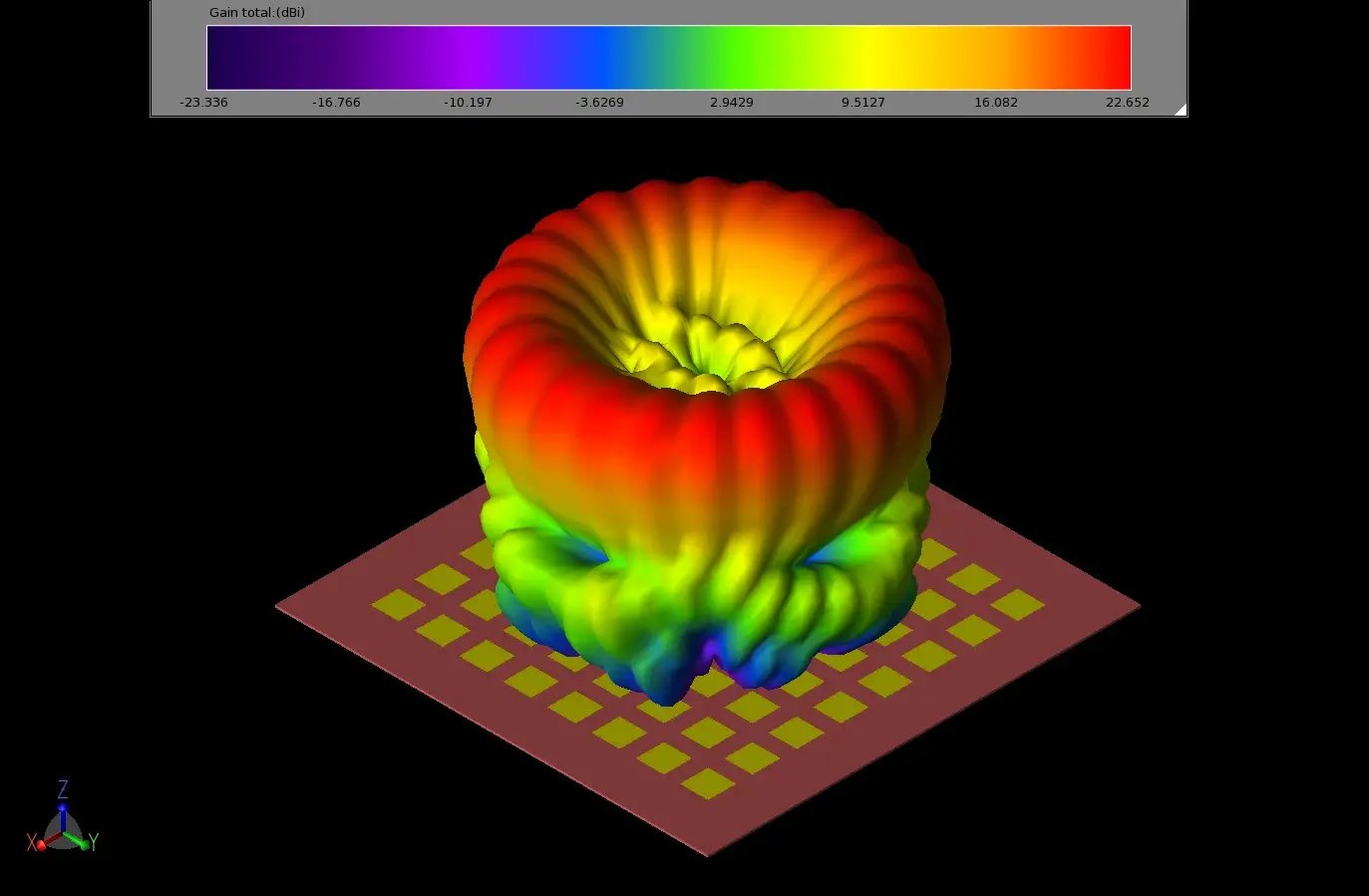 Fig. 2: Patterns of an 8x8 array of patch elements, simulated using the array optimization tool in XFdtd.
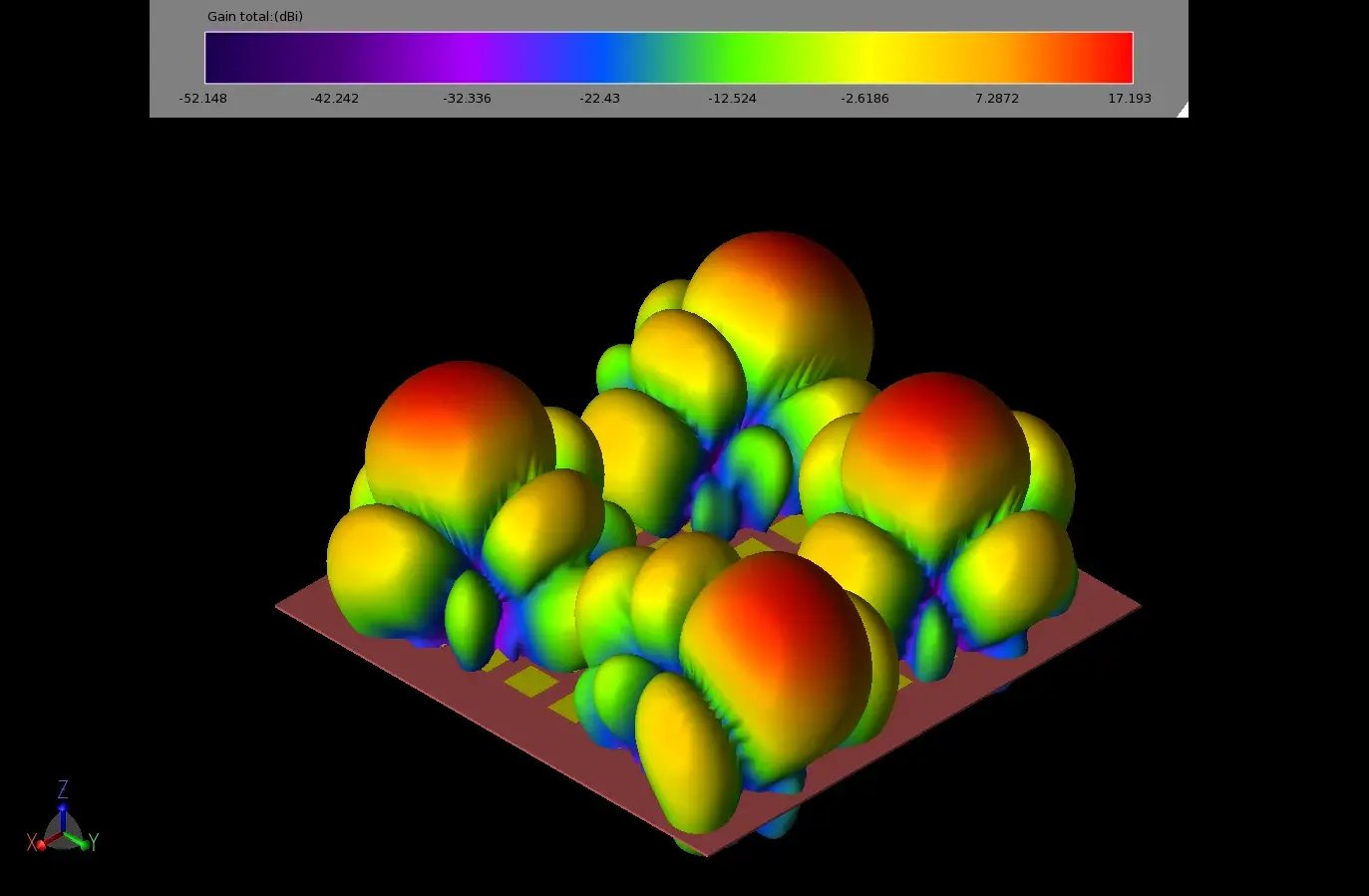 Fig. 3: Patterns of an 8x8 array of patch elements structured as four 4x4 independent subarrays, simulated using the array analysis tools in XFdtd.
Multiple arrays on a single device are used for spatial diversity to provide coverage over a wider range of angles than a single array could produce. A possible use case for this would be a mobile telephone for 5G with multiple arrays located around the edges of the phone. Four arrays located on the sides, top, and bottom of a phone case, as shown in Figure 4, are each four element patch arrays that can produce a steerable beam that covers a wide region normal to the array. When used in combination, the arrays can provide coverage in multiple directions, which is best demonstrated with the CDF of EIRP calculation. This one-dimensional function describes the percentage of the far-field sphere that is covered by an array for a given input power. In Figure 5, CDF of EIRP plots are shown for different combinations of the arrays on the edges of the mobile phone, and it can be seen that the single arrays alone provide positive gain for about 66% (1 – 0.34 from the CDF plot) of the directions for a typical 23 dBmW input power. Coverage improves to about 90% when two arrays in one of the corners are used in combination, and full coverage results when arrays on opposite sides of the phone are used together.
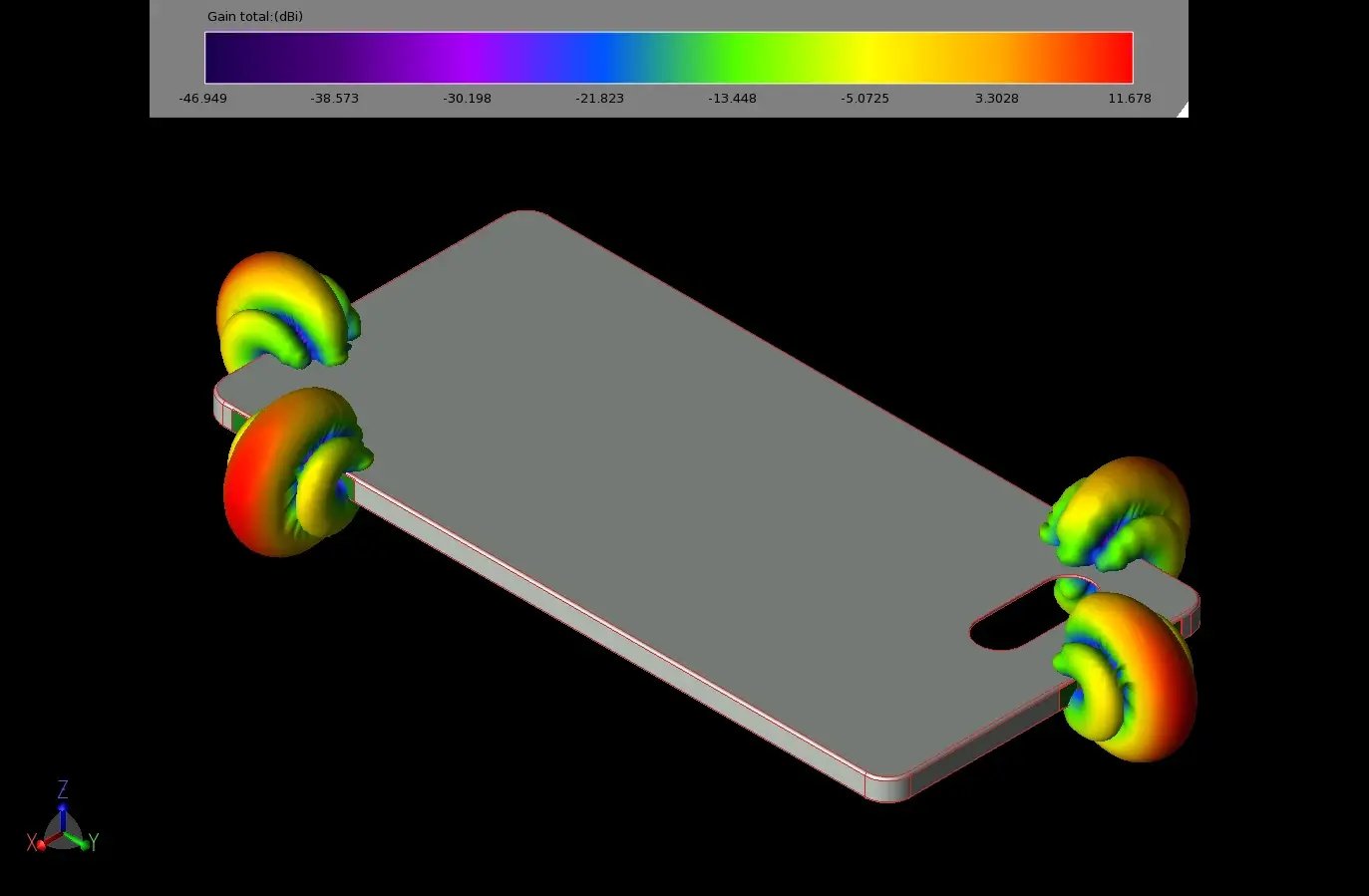 Fig. 4: Four 1x4 patch arrays distributed in a mobile phone to enable wide spatial coverage.
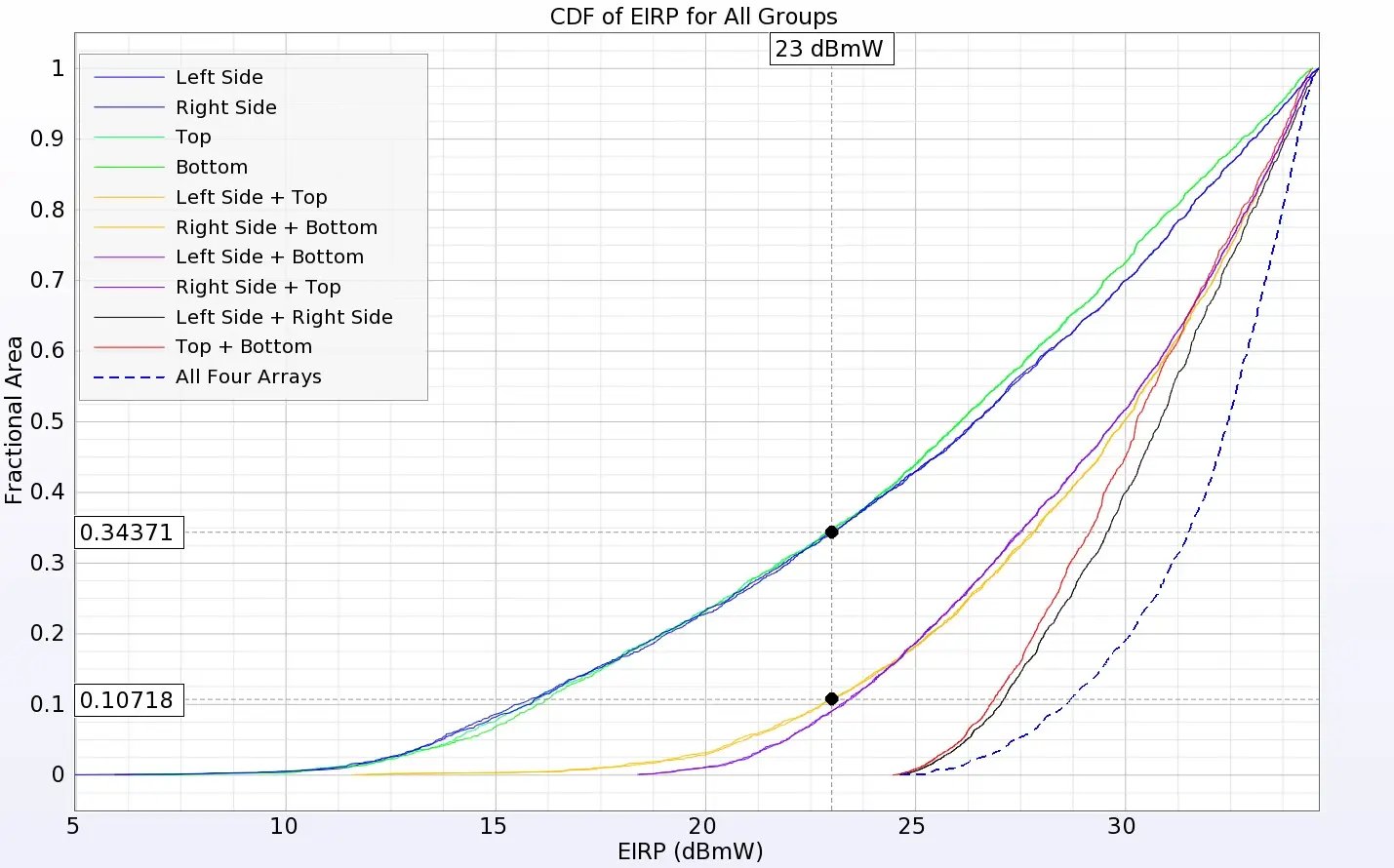 Fig. 5: EIRP CDFs of the patch arrays in the mobile phone.
As device performance is pushed to new levels by the increasing demands of 5G high frequency systems, the need for more comprehensive analysis tools for complex antenna systems continues to grow. XFdtd simplifies the process for understanding device performance by providing efficient ways to validate array coverage.