By Tarun Chawla, Remcom
In the design and development of wireless devices for body-worn applications, several technical challenges must be addressed to ensure reliable on-body RF propagation. Key factors include the materials used in the device, which can influence signal interference, as well as weight, comfort, cost, and compatibility with other system components. Additionally, the human body itself acts as a complex, dynamic part of the antenna structure. Traditional methods like physical prototype testing and human RF engineering are often used to assess antenna performance, but they can require multiple iterations and may not capture all real-world complexities. RF propagation simulations empower engineers to test numerous real-world use cases in far less time, and at lower costs, than in situ testing alone. Additionally, simulations provide a powerful visual aid and offer valuable insights to improve the performance and design of body-worn wireless devices.
Digital Twins of RF Test and Measurement: Challenges and Opportunities
The physical human engineering currently required by the FDA is rooted in preventing potential radiation hazards from devices. It is critical to stay at or below internationally defined radiation thresholds of specific absorption rate (SAR). SAR can be reduced by lowering the system’s power, but this increases the likelihood of lost signals.
Regardless, regulations surrounding simulation have not kept up with advances in technology and technique, nor have they evolved to accommodate consumer market needs. High-volume physical testing is often accessible only to well-off companies whose top-tier products are engineered to be aesthetically beautiful and operate flawlessly, with expert customer support available 24/7. User experience is at the center of design and drives a premium price point.
As product affordability increases, a key change accompanying lower cost is potential reduced functionality—usually the result of reduced system complexity. For example, a device user can locate their lost phone or car, so why not their wireless earbuds? Enabling that capability may increase product weight or cost or change the device shape at the expense of user experience.
Implementing zero-prototype design phases by using simulation can make high-functionality product development faster, more accessible, and less costly.
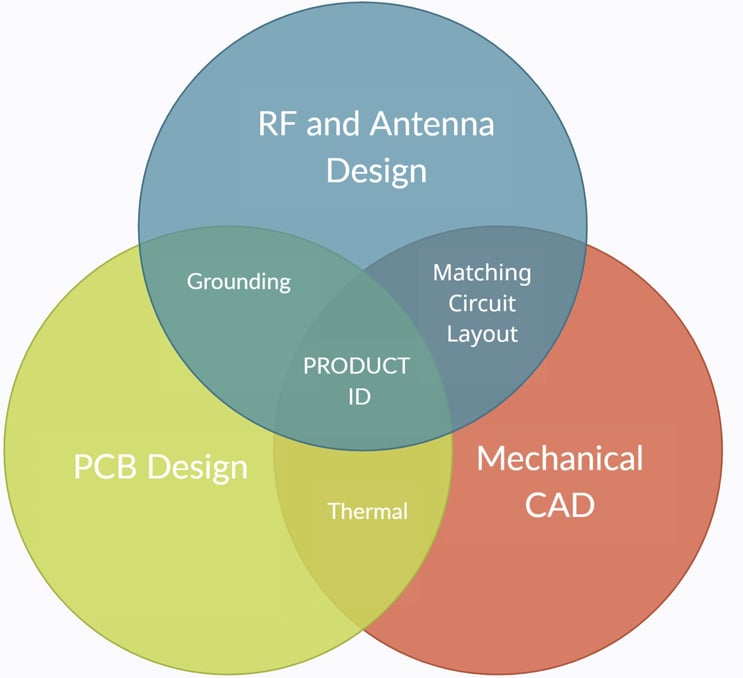 Symbiotic engineering life cycles between mechanical, RF and hardware engineers lead to a successful product design
Initial design (Product ID, center) is controlled by industrial engineers. Mechanical engineers add constraints to make the design feasible: its look and physical feel, for example. Next, PCB engineers create the device’s specifications, such as CPU speed and RAM. For antenna engineers, generational changes among devices primarily consist of enabling and supporting an increased number of frequency bands. That introduces a host of issues dependent upon the frequency, its bandwidth, and the use case.
Thus, designs must be validated and tested across a multitude of scenarios and frequencies to overcome inherent RF propagation challenges, including EMI, desense, coupling losses, tuning matching networks, and accounting for gain pattern changes. If this cross-discipline synergy does not function harmoniously, a consumer product cannot be developed. Once the product RF team readies an approved design, the verification team is tasked with verifying the commercial feasibility—in fact, the effectiveness—of real-life product use.
To optimize this process, the product RF team and the verification team must collaborate closely. In the consumer electronics industry, including cellular and laptop product companies, these groups have been siloed in the past because the number of frequency bands and devices in use were very low. Now, technical complexity abounds, numerous tests must be performed, and the number of device iterations to vet is substantial, so promoting understanding between the teams is paramount. Facilitated by EM simulation, this diplomacy also can help identify edge use cases that require additional simulation and/or physical testing, from novel applications to new wireless device generations.
How On-Body Simulation Works
Simulation can depict a process while requiring zero prototypes. Early-stage industrial design does not need to be proven in hardware. For example, rudimentary earbuds can be shaped like a simple cylinder: adequate to provide proof of concept for design features like antenna placement but with zero chance of the design remaining intact through production.
Manufactured as a prototype, this earbud might be represented as P0; it may not even turn on. After tweaking by various stakeholders—perhaps the structure and shape of the casing evolve, creating a trickle-down effect that impacts PCB and antenna engineers—the next prototype, P1, emerges. While P1 is very different from P0, it still is not manufacturable. Most projects progress through multiple iterations in this way, with costs rising quickly as prototypes are manufactured and tested.
But wireless engineers’ capability to perform effective electromagnetic (EM) modeling, as well as measuring path loss and multipath propagation for systems, has been challenged by increasingly complex and varied use case scenarios. Accordingly, test measurements using prototypes and physical staging areas (e.g., anti-echo chambers) are becoming more time-consuming, tedious, and costly. Fortunately, full wave 3D EM and ray-based techniques have proven accurate and scalable using an “EM twin” in lieu of a physical prototype, and all the data generated by chamber testing prototypes is now provable through simulation.
Consider a test scenario that includes a pair of earbuds, a smartwatch, and a cell phone in the wearer’s back pocket, all operating on a 2.46 GHz Bluetooth connection. The phone, which contains the biggest battery, is the source of the Bluetooth signal. Each device antenna has one port, so the earbuds, watch, and phone combine to form a four-port S-parameter matrix.
In this example, the phone plays music, sending a signal via surface waves (which decay with depth) up the body and into the environment. EM simulation models these waves but, until recently, could do so only in a free-space use case. The effect of the body and the device were considered, but environmental effects on the signal, such as those from the ground, the room, the car, etc., were excluded.
In chamber testing, this effect is captured using a physical whole-body phantom representing the human body. The effect is critical to replicate in simulation, because environmental features can be used to the antenna engineer’s advantage. Energy radiates outward from the antennas in each wearable, interacts with/bounces off nearby surfaces and materials, and then returns to be received by the device antennas. The aim is to keep the signal consistent and to prevent it from dropping.
Remcom can simulate a range of use cases—including dense urban, indoor, non-terrestrial networks (NTNs), 5G UE sidelink, and sensing—anywhere from a few seconds to hours. When considering linear materials and environments, based on the surface equivalence theorem, a radiating system can be represented by a set of electric and magnetic surface current densities on a cuboid entirely enclosing the structure. This cuboid is called a Huygens surface or Huygens box, and it can be used to capture the near-field effects within the box while allowing prediction of how those fields then propagate outward into a larger environment (or vice-versa).
The concept is to capture the near-field region, radiating from antennas on the body, and transfer them to a body that testers can move inside an environment. This is necessary because industrial and mechanical engineers typically design a mobile device based on wireless testing that utilizes a motionless physical dummy; the verification team must test the device in real-world scenarios and environments, which means accurately portraying and gauging the impact of the wearer in motion.
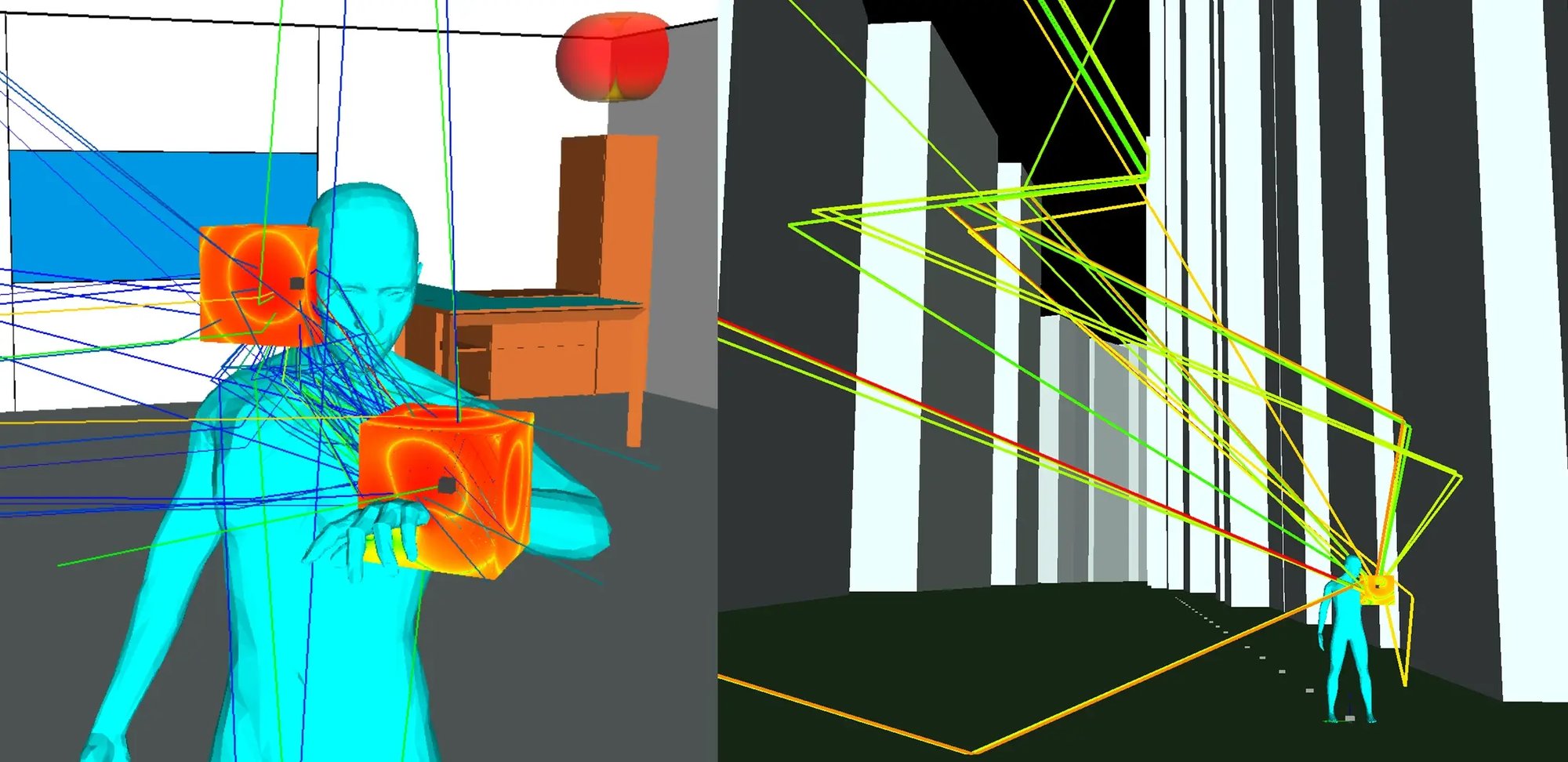 Remcom incorporates near-field antenna effects into simulations of antenna performance so that mobility, multipath, and interactions with body-worn devices may be analyzed in realistic environments.
Moving forward, Remcom is working to shorten run times of test scenarios as much as possible within the constraints of existing technology. The goal is to model the S-parameter matrix for a multitude of human body configurations across various frequency bands while the body is in motion inside an environment. In short, the goal is to model reality, but the task must be broken down into smaller pieces: one frequency at a time, and one position of the human body at a time. As verification teams begin to trust simulation technology more, verification turnaround times and product synergies will improve.
Space, The Final Frontier…
NASA’s Artemis missions, which propose to send astronauts back to the Moon—no earlier than mid-2027, as of this writing—offer a shining example of simulation’s capabilities. NASA has engaged Remcom, Intuitive Machines, Nokia Bell Labs, Lunar Outpost, and Axiom Space to design communications on the Moon and provide astronauts with a high-speed wireless network on the lunar surface. Equipment and devices will be integrated into spacesuits, rovers, and both orbital and surface hubs to facilitate communications, navigation, and critical continuous coverage.
Near-countless use scenarios and potential challenges must be considered when operating in such a unique environment. For example, in terms of in-motion, on-body propagation, the reflective properties of astronauts’ suits will impact handheld devices’ RF performance and the depth/curvature of craters on the Moon will impact communications link performance. In response, Remcom is creating a complete, end-to-end modeling and simulation solution to explore lunar channel simulation and analyze coverage.
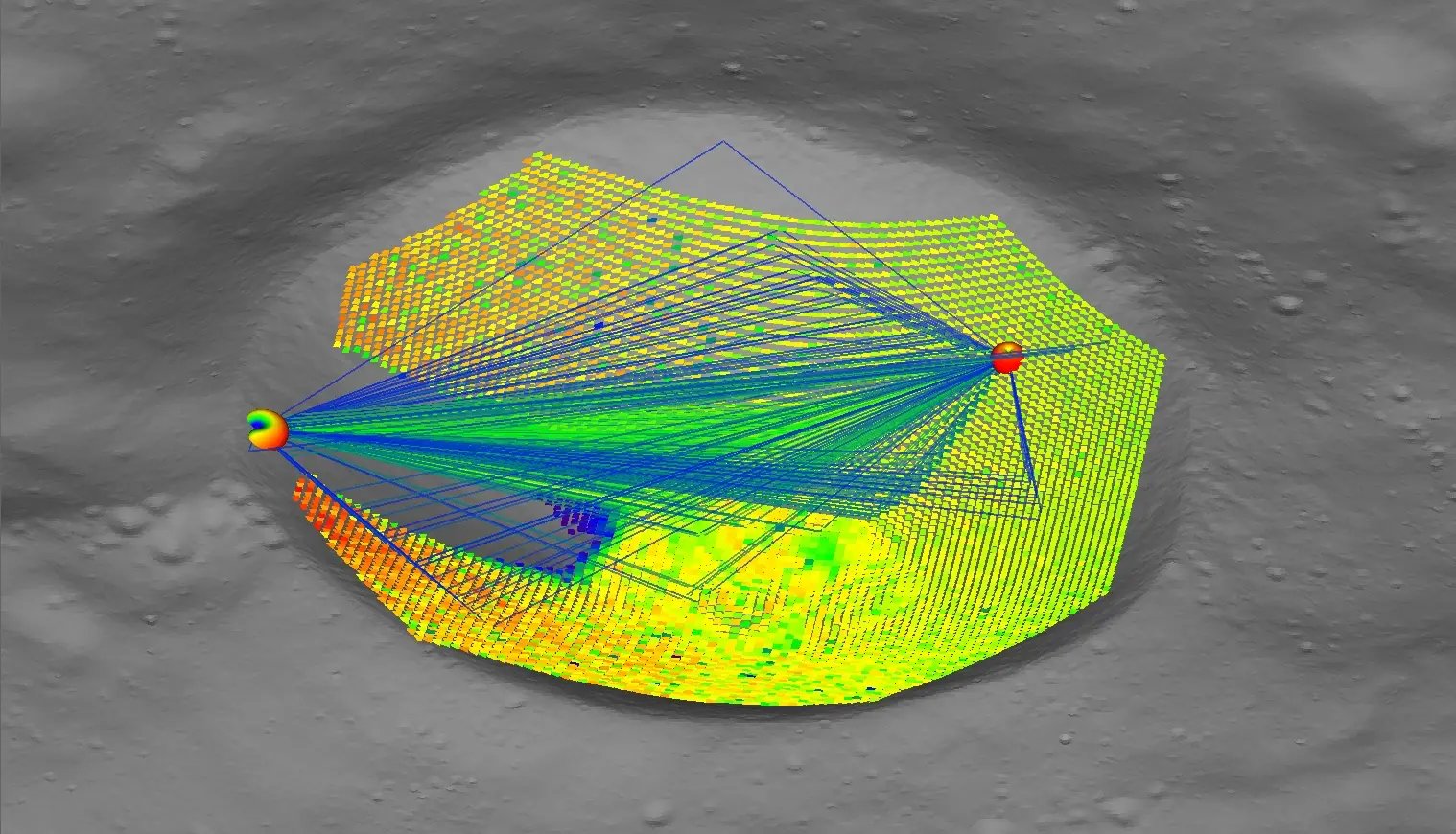 Wireless InSite simulation of coverage and multipath within a lunar crater
This enhanced version of Wireless InSite® incorporates new data and algorithms to optimize simulation of lunar surface materials and terrain. It improves users’ ability to define physical and electrical properties of regolith and bedrock and enables them to develop model enhancements for surface/subsurface scattering. It also includes post-processing tools for link-level simulation so users can determine the impact of key phenomena in lunar scenarios.
NASA’s Extravehicular Activity and Human Surface Mobility Program has several efforts to practice effective spacewalking, roving operations, and mobility scenarios, completing tech demonstrations and science related activities in Arizona and Nevada. During these tests, astronauts wear prototype space suits equipped with antennas designed to assess the impact of craters on communication signals and data links in Flagstaff, AZ. The data gathered from these trials will inform the development of enhanced wireless connectivity models combined with Remcom’s predictions for the Moon's South Pole, an area with analogous terrain that presents similar challenges to establishing reliable wireless infrastructure.
Simulations of past Apollo missions, along with available data from various S-band channels, offer valuable insights for predicting and optimizing performance to minimize interference in spectrum management. One example involves evaluating the coverage of wireless base stations, such as 4G and Wi-Fi systems, to meet the communication needs of live-streaming astronaut body cameras to the internet. Another critical scenario involves ensuring secure communication links to protect mission-critical information from interception. Achieving these objectives will necessitate comprehensive network planning and spectrum management strategies, such as those being developed by the NTIA’s Institute for Telecommunication Sciences (ITS), US SG3 and ITU-R SG3. Remcom is actively contributing with the FCC, NTIA and NASA on the lunar propagation modeling efforts and standardization.
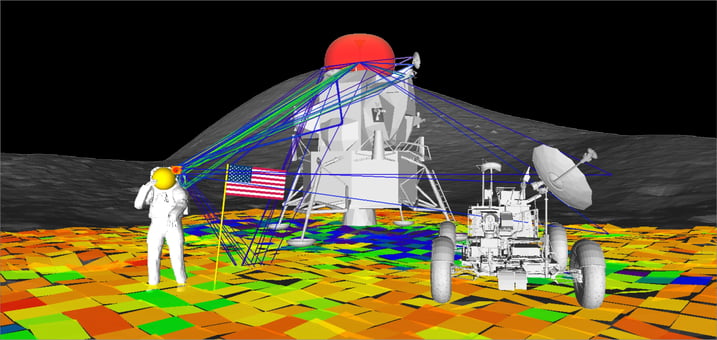
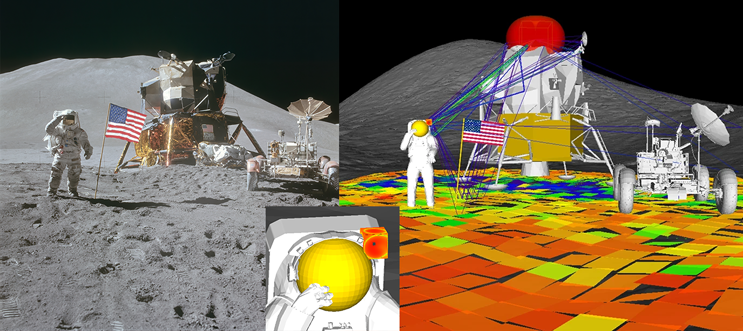 RF Digital Twin of Apollo 15 Mission: Wireless InSite simulation of coverage and multipath from an antenna mounted on the lunar lander to a near-field Huygens antenna on the astronaut’s helmet. Huygens antenna result generated by Remcom’s XFdtd full-wave 3D EM simulation software. Photo credit: Project Apollo Archive, public domain, via Wikimedia Commons
Simulating mission-critical aerospace and military applications has helped inform and refine Remcom’s capability in this respect. For example, the company currently has a U.S. Air Force contract to model thermal heating of the human body. This is applicable to numerous use cases, including soldier-worn radios: how many should each soldier wear, location on the body, and how far apart to ensure optimal connectivity and longevity, plus minimal interference. Additionally, commercial use cases such as automotive in-cabin sensing and child presence detection and healthcare-based monitoring provide life-saving examples of RF and radar technologies.
Simulation Combines Accuracy and Effectiveness for Channel Emulators
Remcom’s high-resolution human body models, represented at a one-millimeter resolution, capture the dielectric properties of various body tissues, including skin, blood, and bones. While this level of precision is essential for applications like implantables and MRI coil design, a simpler human model representation is sufficient for consumer electronics and wearable devices.
Wireless performance in dynamic, multipath environments—such as urban areas, densely populated indoor spaces, or regions with reflective surfaces—presents significant challenges for antenna design. The human body itself creates complex RF interactions, and multipath propagation can lead to signal degradation, interference, and poor user experience. It is critical for antenna, wireless over-the-air (OTA), and RF system engineers to optimize antenna placement, assess the need for MIMO, and predict how RF signals propagate and interact with the body in motion.
In the RF lab, sophisticated measurement equipment such as anechoic chambers, vector network analyzers (VNAs), test antennas, and signal generators are used. The integration of simulated channel impulse responses (CIRs) from Remcom Wireless InSite into channel emulators like Spirent Vertex and Keysight PropSim creates a powerful ecosystem for correlating simulation results with real-world OTA measurements. This technique to evaluate radio environments is known as channel sounding, which involves transmitting known test signals and analyzing the received signal's impulse response to characterize the channel's reflections, delay spread, and multipath effects. This correlation process enables engineers to validate their simulations against physical test results, refining wireless channel models to better represent real-world propagation conditions that cannot be replicated in the lab. The derived model can then be expanded by varying physical room layout, furniture configurations, human positions, etc. accounting for numerous wireless performance criteria.
Once validated, these correlated channel models can be used to generate Tap Delay Line (TDL) or Cluster Delay Line (CDL) models for each emulator hardware type. In the wireless PHY layer, these delay line models help simulate realistic signal propagation conditions, which are then used to generate I/Q (in-phase and quadrature) signals for system-level simulations. Then, AI/ML algorithms can be employed to optimize the design and performance of wireless chipsets by adapting the system's parameters, such as modulation schemes, error correction techniques, and power control strategies, based on real-time channel conditions derived from the validated models. This end-to-end simulation-to-measurement integration creates a digital twin for RF systems, providing a detailed, optimized workflow that mimics the “chip-to-channel” process in wireless device development. Ultimately, this approach ensures more efficient, cost-effective development, delivering high-performance, reliable next-generation wireless devices.
 About The Author
Tarun Chawla is the director of business development at Remcom and an electrical engineer with over 16 years of experience developing and supporting simulation solutions for innovative engineering teams worldwide.